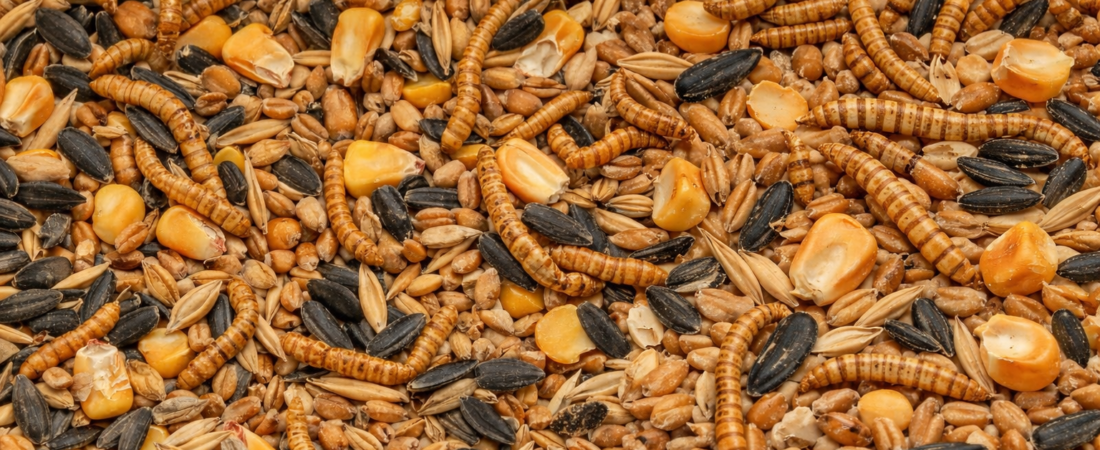
A closer look at protein, fat, and biologically appropriate nutrition.
Mealworms are increasingly recognized as a biologically appropriate ingredient in poultry nutrition. This article explains why dried mealworms work so well in complete poultry feed, how we use them responsibly, and where they fit nutritionally.
- Mealworms: a natural source of protein and fat
- Digestibility and nutrient utilization
- Palatability and natural feeding behavior
- Why a 4% inclusion rate?
- How mealworms fit into our complete ration
- Layer feed vs. all-flock feed: where mealworms fit
- Farmed in-house at Bryer Milling
- In closing
- Order now:
- Interested in Starting Your Own Mealworm Farm? Start here:
As more poultry keepers pay closer attention to what goes into their feed, ingredients that mirror a chicken’s natural diet are gaining well-deserved attention. One of the most effective, and increasingly well-researched, ingredients is the dried mealworm (Tenebrio molitor). Far from being a novelty or “treat-only” ingredient, mealworms can play a meaningful role in a balanced poultry ration when used correctly.
In our Poultry All-Flock Feed, dried mealworms make up 4% of the complete formula, working alongside grains, legumes, seeds, forages, and a comprehensive vitamin–mineral premix to support long-term flock health.
Mealworms: a natural source of protein and fat
Chickens are omnivores by nature. Insects make up a significant portion of what free-ranging birds instinctively seek out, especially during periods of growth, laying, or recovery from stress. Dried mealworms closely resemble this natural food source and offer a concentrated package of nutrients.
On average, dried mealworms contain:
- 45–55% crude protein
- 25–35% fat
- Highly digestible amino acids, including lysine and methionine
- Naturally occurring B vitamins and trace minerals
This combination makes mealworms both a protein source and an energy source, something that plant-based ingredients alone cannot always provide as efficiently.
Digestibility and nutrient utilization
One of the key advantages of insect protein is digestibility. Poultry are able to efficiently break down and utilize mealworm protein, directing those nutrients toward muscle maintenance, feather growth, egg production, and immune support.
The fat fraction in mealworms provides readily available energy, helping birds maintain body condition without relying solely on starch-heavy grains. This can be especially helpful during colder months, molting, or periods of high production.
Freshness plays an important role in how effectively birds utilize protein and fat in any feed.
Palatability and natural feeding behavior
Anyone who has ever tossed a handful of mealworms to a flock knows how strongly the birds respond. That same palatability carries over when mealworms are included directly in the feed. Improved palatability encourages consistent feed intake, which is critical for maintaining steady nutrient consumption across the flock.
In addition, insect-based ingredients support natural foraging instincts, which may contribute to reduced boredom-related behaviors and improved overall flock well-being.
Why a 4% inclusion rate?
In this feed, dried mealworms make up 4% of the total formula—a level chosen intentionally based on the nutritional requirements of poultry.
At this inclusion rate:
- Mealworms contribute meaningful, biologically appropriate protein and fat
- Amino acid balance remains appropriate for mixed-age and mixed-purpose flocks
- The diet remains stable, economical, and nutritionally complete
Rather than relying on a single protein source, mealworms complement plant proteins such as soybean meal and peas, improving overall protein quality without overwhelming the formulation.
How mealworms fit into our complete ration
Mealworms are just one part of a carefully balanced formula that includes:
- Corn, wheat, oats, and barley for digestible energy
- Soybean meal and peas for plant-based protein support
- Black oil sunflower seed (B.O.S.S.) for additional fat and vitamin E
- Alfalfa and timothy pellets for fiber and micronutrients
- Beet pulp and wheat bran to support digestive health
- Calcium carbonate and monocalcium phosphate for skeletal and eggshell support
- A vitamin–mineral premix with probiotics and fermentation products to support nutrient absorption, gut health, and immune function
Together, these ingredients ensure that the protein and fat provided by mealworms are fully supported by minerals, vitamins, and digestive aids.
Layer feed vs. all-flock feed: where mealworms fit
All-flock feeds and layer feeds serve different purposes, even when they share high-quality ingredients like mealworms. All-flock feed is formulated to support birds of mixed ages and production stages, chicks, growers, non-laying adults, roosters, and laying hens, without excess calcium that could harm non-layers. In this context, mealworms provide flexible protein and energy that benefit the entire flock. Layer feeds, on the other hand, are specifically formulated with higher calcium levels to support eggshell production in actively laying hens. For mixed flocks or households with birds at different life stages, an all-flock feed with balanced protein sources like mealworms, and free-choice oyster shell for hens, is often the most practical and safest choice.
Farmed in-house at Bryer Milling
At Bryer Milling, the mealworms used in our Poultry All-Flock Feed are raised on-site, giving us full oversight of their quality from start to finish. Rather than relying on anonymous bulk insect meal, we manage the rearing, harvesting, and drying process ourselves.
Farming mealworms in-house allows us to:
- control what the worms are fed
- ensure consistent cleanliness and handling
- monitor freshness and quality at every stage
- avoid unnecessary fillers, preservatives, or unknown sourcing
Because we raise our own mealworms, we can include them in the feed at a functional level, not as a marketing afterthought, but as a purposeful ingredient that fits the nutritional goals of the formula.
This closed-loop approach also supports sustainability and reduces supply chain uncertainty. More importantly, it ensures that the insect protein going into our feed meets the same standards we hold for every ingredient we use, the same ingredients we are comfortable feeding to our own animals.
In closing
Mealworms are more than a treat, they are a biologically appropriate, nutrient-dense ingredient that supports poultry health when used thoughtfully. At a 4% inclusion rate within a complete, fortified feed, mealworms contribute high-quality protein, beneficial fats, and improved palatability while working in harmony with grains, legumes, minerals, and probiotics.
This balanced approach reflects both modern nutrition research and the natural dietary needs of poultry, bringing the two together in a way birds and keepers can both appreciate.
Interested in Starting Your Own Mealworm Farm? Start here:
References
Makkar et al. (2014).
Insects as animal feed.
Animal Feed Science and Technology.
AAFCO (Association of American Feed Control Officials).
Official Publication.
National Research Council (NRC).
Nutrient Requirements of Poultry. National Academies Press.
Bovera et al. (2016).
Use of Tenebrio molitor larvae meal as a protein source in poultry diets.
Journal of Animal Science and Biotechnology.
G.F. Heuser (1955).
Feeding Poultry:The Classic Guide to Poultry Nutrition for Chickens, Turkeys, Ducks, Geese, Gamebirds, and Pigeons.
John Wiley & Sons